Business acquisition loan rates in 2026
Buying a business usually runs on an SBA 7(a) loan at prime plus up to 3%. How the capital stack works, the 10% equity rule, and what each source of money costs.

Buying a business usually runs on an SBA 7(a) loan, priced at prime plus a spread of up to 3%, which puts the ceiling near 9.75% at today’s 6.75% prime rate. That’s the workhorse of acquisition financing, because the SBA guarantee lets a bank lend against a business’s cash flow and goodwill, not just hard collateral. Most deals blend that loan with a seller note and a slug of your own cash, and the SBA generally wants at least 10% of the deal to be a real equity injection.
The rate is only half the question. The other half is the capital stack: how the purchase price gets split between the loan, the seller, and you. Get that structure right and a deal that looks unaffordable becomes financeable. Here’s what each piece costs, how much you actually need to put down, and how the pieces fit.
The capital stack: who funds what
A business purchase is rarely one loan for the whole price. It’s a stack, and the SBA 7(a) is usually the biggest layer.
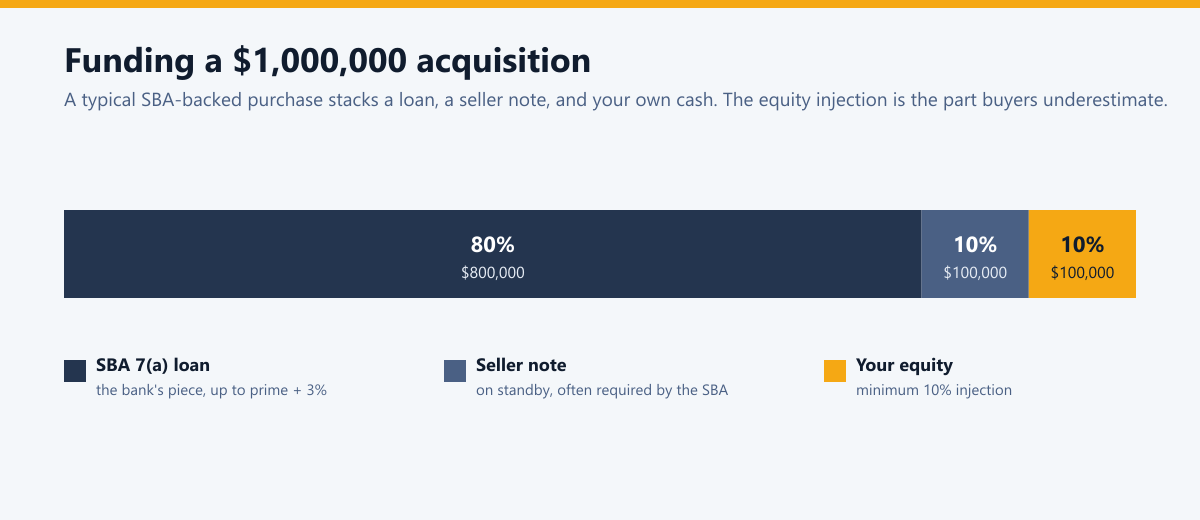
The SBA loan is the foundation, often funding 80% or so of a straightforward acquisition. A seller note, where the seller agrees to be paid part of the price over time, commonly bridges another slice, and the SBA frequently requires that note to sit on full standby, meaning the seller collects nothing until the SBA loan is repaid or well seasoned. Your equity injection is the smallest layer but the non-negotiable one: the SBA generally wants at least 10% of the total project cost as real skin in the game. Some of that 10% can come from a standby seller note in certain cases, but a genuine portion has to be your own cash. That equity rule is the single fact that most surprises first-time buyers.

What each source of money costs
The three layers of the stack don’t carry the same rate, and the blend across them is your true cost of capital.
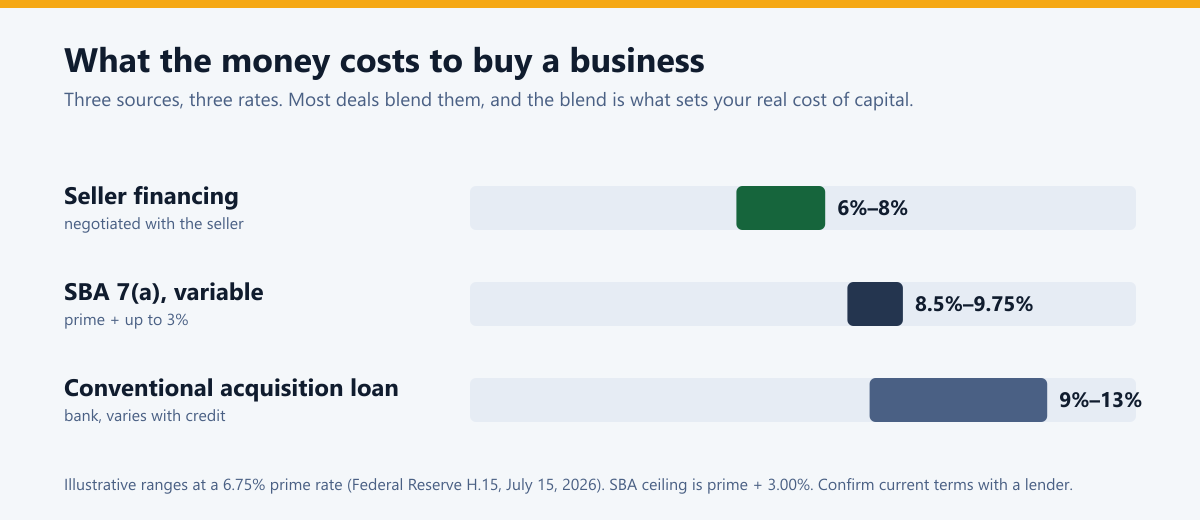
The SBA 7(a) rate is variable, set at prime plus a spread the lender chooses up to the SBA’s maximum, which is 3% for most acquisition-sized loans. At a 6.75% prime rate, that caps the rate near 9.75%, and because the SBA sets the ceiling, the lender can’t exceed it. A conventional bank acquisition loan has no such cap; it can price lower for a strong borrower with collateral, or higher and out of reach for a business without real estate to pledge. Seller financing is the wildcard, negotiated directly with the seller, and it often lands in the 6% to 8% range because a seller motivated to close will carry paper cheaper than a bank. A deal that blends a capped SBA loan with a modest seller note frequently beats any single source. Price the SBA piece with the SBA payment calculator so you know the monthly number before you negotiate the rest.
Making the deal financeable
The business you’re buying has to carry its own loan. Lenders underwrite the target’s cash flow, checking that its earnings comfortably cover the new debt payments, which is why a quality of earnings review of the seller’s numbers matters as much as the rate. A business with clean, verifiable, sufficient cash flow gets financed; one with shaky books doesn’t, no matter how attractive the price.
If the purchase includes the building, an SBA 504 loan may fund the real estate more cheaply than folding it into a 7(a). And once you own the business, working-capital tools like asset-based lending or an SBA 7(a) line fund the growth that comes next. The financing router maps your situation to the structure that fits. Your rate, the exact equity requirement, and your eligibility all come from an SBA lender working under the current SOP, so confirm all three before you sign a letter of intent. The equity injection is the one that kills deals late: get the lender’s written position on how much of your 10% can come from a standby seller note before you agree a price, not after.