Revenue-based financing: how it works and costs
Revenue-based financing repays a share of monthly sales up to a capped multiple. Gentler than a cash advance, but the effective APR still lands at 20% to 60%.

Revenue-based financing gives you a lump sum and collects it back as a fixed share of your monthly revenue, usually 3% to 8%, until you’ve repaid a capped multiple of what you borrowed, commonly 1.3 to 1.5 times. Borrow $200,000 at a 1.4 cap and you’ll repay $280,000, but as a percentage of each month’s sales rather than a fixed payment. That flexibility is the whole appeal, and the flat multiple is the whole catch.
It sits in the middle of the cost spectrum: gentler and cheaper than a merchant cash advance, far more expensive than a bank line or an SBA loan. For a growing ecommerce or subscription business with strong revenue but no assets to pledge, it can be a reasonable bridge. Priced as an annual rate, though, it still lands at 20% to 60%, so it pays to know exactly what you’re signing.
How the repayment actually works
The mechanics are simple, and they’re the reason the product exists.
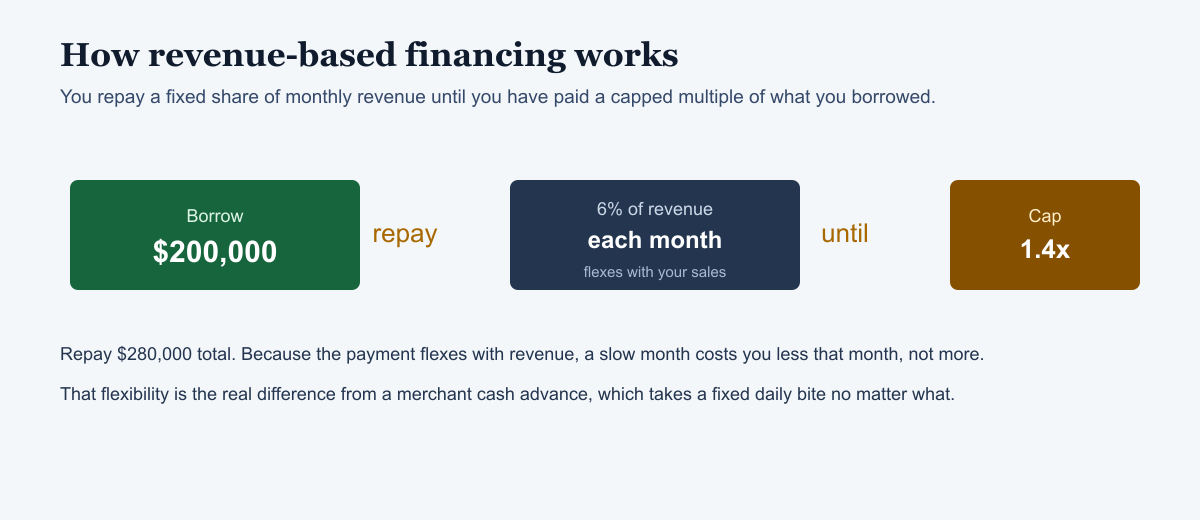
Because repayment is a percentage of sales, it breathes with the business. A slow month automatically means a smaller payment, so RBF doesn’t crush you in a downturn the way a fixed obligation can. There’s usually no personal guarantee and no equity given up, which is why venture-scale software and ecommerce companies reach for it to fund growth without diluting founders.

The cost, told honestly
Here’s the catch the flexibility can hide. The cap is a flat fee, not an interest rate, and a flat fee repaid over months is a high annual rate. A 1.4 cap looks like 40%, but you don’t repay over a full year, you repay as fast as your revenue allows, which means the effective APR is higher, and paying it off faster actually raises the rate rather than lowering it.
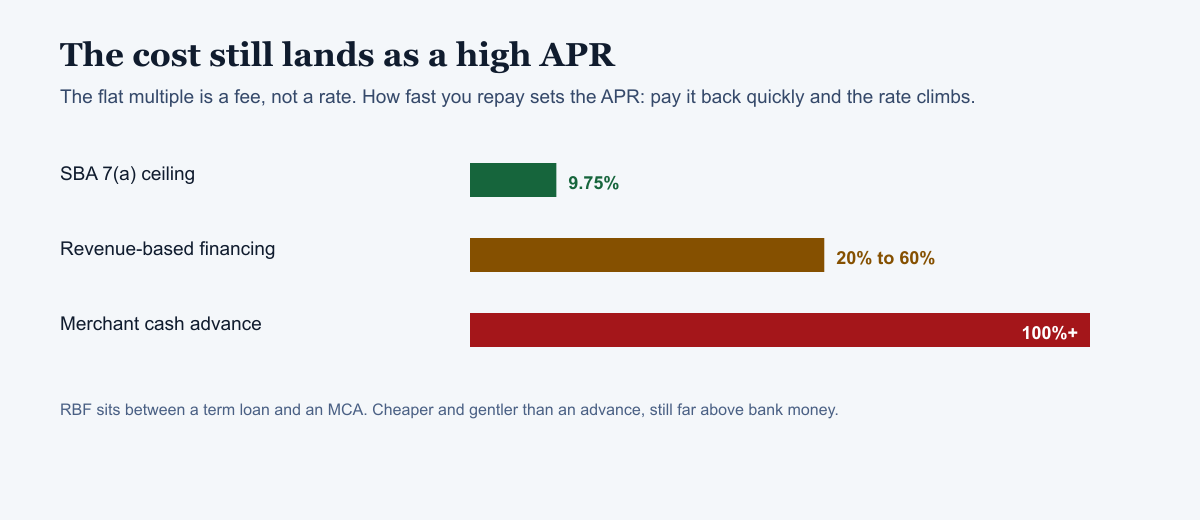
Put your own numbers into the true-cost calculator to convert the cap into an annual rate you can compare against everything else. The point isn’t that RBF is bad. It’s that “1.4” is a fee dressed as a small number, and you should see the rate before you decide it’s worth the flexibility.
When it makes sense, and the cheaper doors to try first
RBF earns its cost in a specific spot: you have strong, predictable revenue, you’re growing faster than a bank will underwrite, you have few hard assets to pledge, and you don’t want to give up equity. For a software or ecommerce business, that describes a real and common moment.
But it’s expensive money, so try the cheaper doors first. A bank term loan or an SBA loan prices in the teens or lower if you can qualify. If your cash is tied up in receivables, invoice factoring may be cheaper. And if a cash advance is the alternative, RBF is the better of the two, but the true-cost calculator will show you exactly how much better. The financing router will point you at the cheapest structure you actually qualify for. Before you sign, check two terms that move the real cost more than the cap does: the revenue percentage, because a high share starves the working capital the money was meant to fund, and whether there is a minimum monthly payment floor, which quietly converts a “flexes with your sales” product into a fixed obligation in exactly the month you needed the flexibility.