Bonus depreciation in 2026: back to 100%
Bonus depreciation is back to a permanent 100% for assets acquired after January 19, 2025. What it means for equipment, buildings, and cost segregation.
Bonus depreciation is back to 100% for 2026. The One Big Beautiful Bill restored it to a permanent full write-off for qualifying property acquired after January 19, 2025, which means a business can expense the entire cost of equipment, machinery, and other short-life assets in the year it puts them to work, instead of deducting a slice at a time over years.
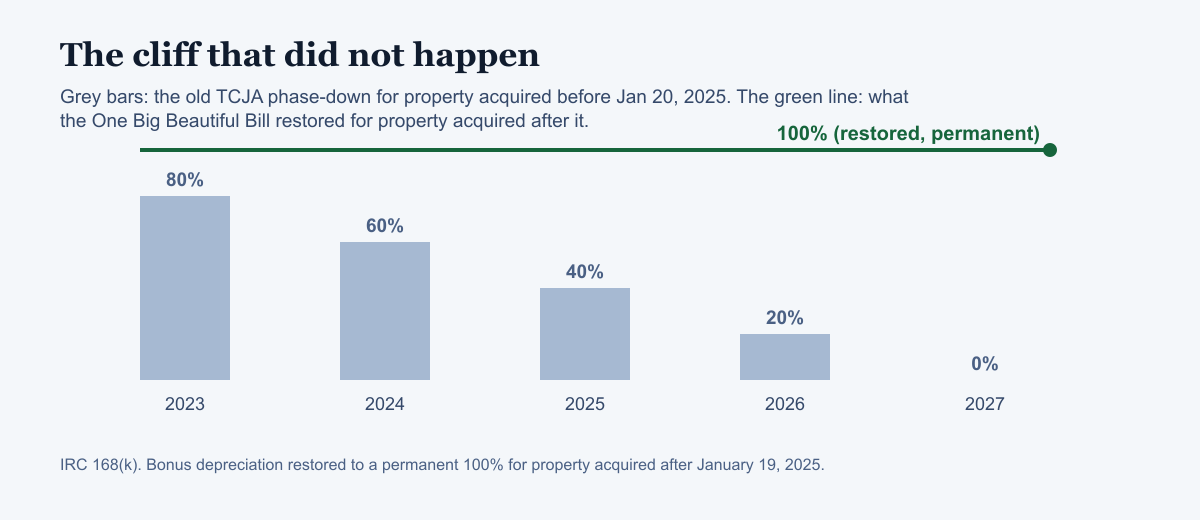
That reverses a countdown that was already running. Under the earlier rules, bonus depreciation was fading out: 80% in 2023, 60% in 2024, 40% in 2025, and it was set to drop to 20% in 2026 and vanish in 2027. Property you acquired before January 20, 2025 still follows that phase-down. Everything after it gets the full 100% again.
The cliff that stopped mid-fall
For most of a decade, bonus depreciation was a use-it-or-lose-it clock. The 2017 tax law set it at 100%, then wrote in a phase-down that clawed twenty points off every year starting in 2023. A business planning a big equipment purchase had to weigh the tax timing against a shrinking benefit, and by 2026 that benefit was down to a fifth of what it once was.
The One Big Beautiful Bill reset it, and this time without an expiration date. For property acquired after January 19, 2025, the rate is 100% and the statute makes it permanent.
What 100% actually does to a purchase
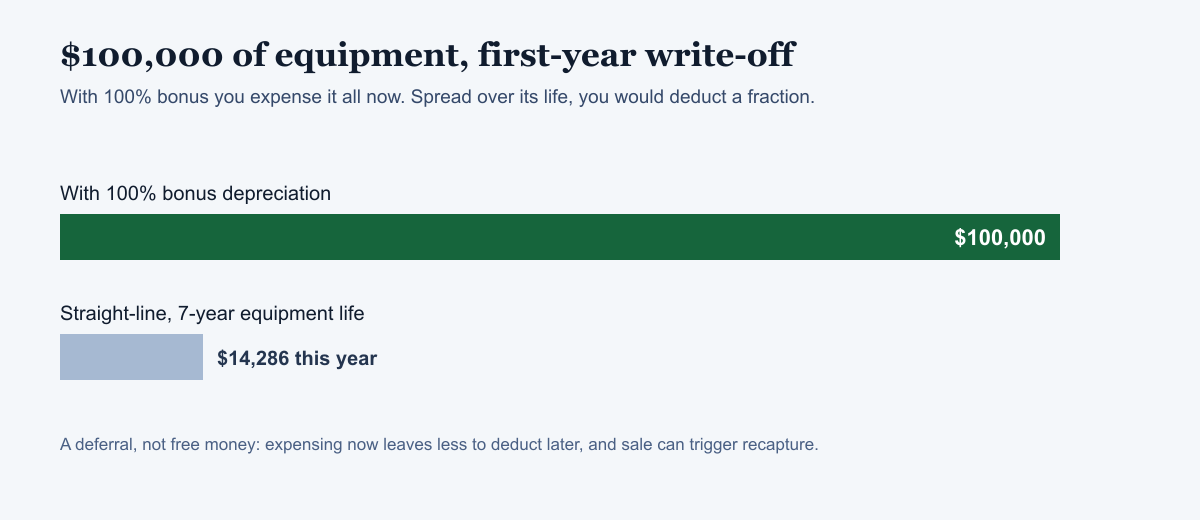
Normally a business capitalizes equipment and deducts it over a set recovery period, five years for a lot of machinery, seven for other gear. Bonus depreciation lets it skip the schedule and deduct the whole cost in year one.
On $100,000 of equipment, that’s the difference between a $100,000 deduction now and roughly $14,000 this year under a straight seven-year line. The rest of the deduction doesn’t disappear either way. Bonus just pulls all of it into the first year, when it can offset income you’ve already earned.
Qualifying property is anything with a MACRS recovery period of 20 years or less. That’s a wide net: machinery, vehicles, computers, office furniture, and qualified improvement property, the interior work on a commercial building. If you can put it on the books with a life of two decades or less, it likely qualifies.

Why this makes cost segregation worth a second look
A building itself depreciates over 39 years, far too long to qualify for bonus. But a building is not one asset. A cost segregation study breaks it into parts and reclassifies the ones that really belong in 5, 7, and 15-year classes: the special-purpose wiring, the fixtures, the site work, the finishes. Those parts do qualify for bonus.
So with 100% bonus back, a study that moves 25% of a building’s basis into short-life property can turn that whole slice into a first-year deduction rather than a trickle over four decades. That’s why the restoration matters most to real estate owners: it’s what makes the cost segregation math pay again, and our calculator lets you run your own building against it.
The part the enthusiasm skips
A full first-year write-off is real money, and it is still a deferral, not a discount. Expensing an asset now means there’s nothing left to depreciate on it later, so future years lose that deduction. And when you sell, depreciation recapture can tax back the benefit at ordinary rates. The gain is the time value of holding that tax money in the meantime, which is large if you’ll keep the asset for years and small if you’re about to flip it.
There’s also a choice buried in the rules: you can elect a lower rate, 40% or 60%, instead of the full 100% for a tax year. That sounds strange until you have a year with little income to shelter, where a giant deduction is wasted and you’d rather spread it forward. Which way is right depends on your income, your entity, and your plans, so run the number, then take it to your CPA. This is an estimate and a summary, not tax advice. See the rest of the tax incentives section.