WOTC in 2026: expired, but file Form 8850 anyway
The Work Opportunity Tax Credit expired December 31, 2025 and is in hiatus. Why the 28-day filing deadline still matters, and what employers should do now.

The Work Opportunity Tax Credit is not available for anyone you hire in 2026. It expired on December 31, 2025, and Congress has not renewed it. If you hire someone today, there is no federal hiring credit waiting behind that hire, and there may never be one for it.
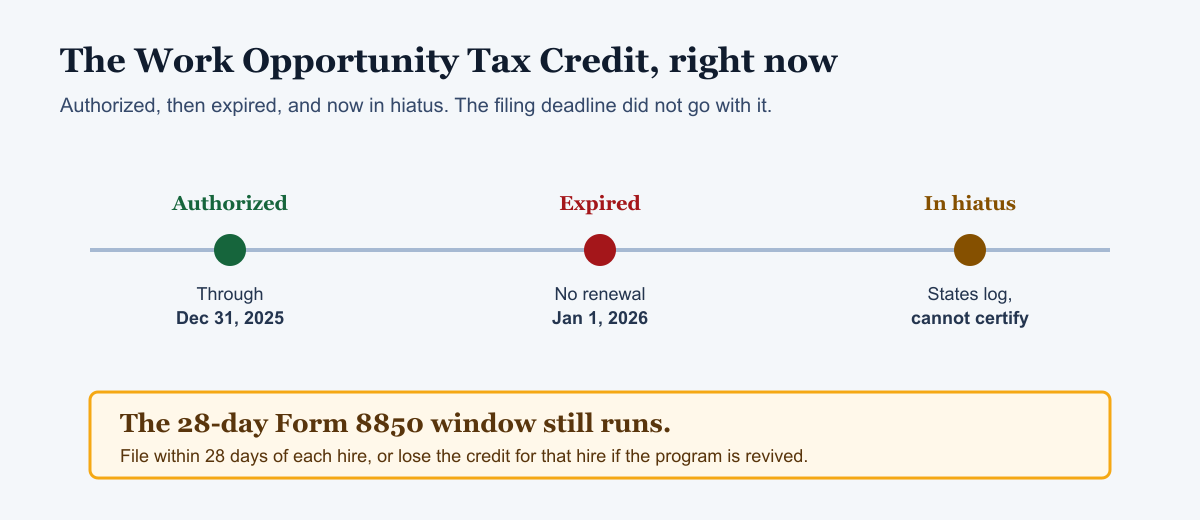
Here is the part almost every stale guide gets wrong: you should file the paperwork anyway. The 28-day deadline to submit Form 8850 still runs during the hiatus, and the reason it matters is history. This credit has lapsed before and come back with retroactive coverage, and when it did, only the employers who kept filing on time could claim it.
What actually happened, and when
WOTC gave employers a credit for hiring people from specific groups that face barriers to work: certain veterans, people who had been on long-term public assistance, ex-felons, SNAP recipients, and a handful of others. The authorizing language sat in Section 51 of the tax code, and that language carried an expiration date.
The last extension, in the Consolidated Appropriations Act signed in December 2020, ran the credit through December 31, 2025. That date has now passed with no replacement. Section 51(c)(4) still reads that wages do not include any amount paid to an individual who “begins work for the employer after December 31, 2025,” in the U.S. Code as it stood on July 16, 2026. If a bill had reauthorized it, that text would say something else. It doesn’t.
”Hiatus” is a specific thing, not a synonym for gone
A lapse like this doesn’t switch the program off cleanly. The state workforce agencies that process WOTC certifications are, in the words of one of them, still able to “accept, date stamp, log, and retain” your certification requests. What they cannot do is issue any certification or denial for someone who started work in 2026. The request goes into a queue that has no exit until Congress acts.
That queue is the whole reason to keep filing. A certification request logged on time is a live claim if the credit returns. A hire you never filed for is gone, no matter what Congress does later.

Why filing into a frozen queue is the rational move
WOTC has expired and been revived before. It lapsed and was later reinstated with retroactive effect, so employers who had kept their screening and paperwork current could still claim credits for hires made during the gap. The Congressional Research Service documents this on-again, off-again pattern across the credit’s history.
So the expected value of filing is not zero, even now. It costs you a form and a mailing inside 28 days of each hire. If the credit never returns, you’re out that small effort. If it returns retroactively, which is how this has gone before, you have a live, dated claim on a credit worth up to $2,400 for most workers and up to $9,600 for certain veterans. That is a lopsided bet in favor of filing.
The math on the credit itself is simple: 40% of the first $6,000 of qualified first-year wages, so $2,400 per qualifying employee, with a larger $24,000 wage base for certain veterans. Run enough qualifying hires through it and the numbers stop being a rounding error, which is exactly why it’s worth protecting the option.
What’s actually in front of Congress
There is legislation to bring it back. A bipartisan bill introduced in late 2025 would extend the credit for five years, through the end of 2030, raise the credit rate from 40% to 50%, and add hires of military spouses to the eligible groups. Introduced is not enacted, and we’re not going to tell you it’s a sure thing. As of this writing it has not passed either chamber, and a bill can sit in committee for a full session and die there.
What we can tell you is what the statute says today, and today it says the credit stopped at the end of 2025. Anyone quoting you a live WOTC benefit for a 2026 hire is quoting a credit that isn’t currently there.

What to do now
Keep your hiring screen running exactly as if the credit were live. Have each new hire complete the WOTC questionnaire on or before their start date, submit Form 8850 to your state workforce agency within 28 days, and keep the dated confirmation. If the credit returns retroactively, that file is what turns a past hire into a claim.
For hires made on or before December 31, 2025 that you never certified, it may not be too late: states are still processing timely-filed requests for those earlier hires, and certifications for them can still be issued. Check whether any 2025 hire slipped through unfiled.
If you’re weighing hiring credits against your other tax moves, the credit that is actually live right now is the research credit, not this one. Our R&D tax credit estimate gives you a ballpark in under a minute, and the rest of the tax incentives section covers the deductions that survived into 2026. If you’re also raising capital this year, the financing calculators price what that money actually costs before you sign.
None of this is tax advice: confirm your own filing with a licensed professional who has seen your books. And if Congress reauthorizes the credit retroactively, which is how the last several hiatuses ended, the businesses that kept filing Form 8850 within 28 days of each hire are the ones that will be able to claim it. That paperwork costs nothing to keep doing and is worthless to start doing late.