Quality of earnings cost: what a QoE report runs
A quality of earnings report runs $15,000 to $150,000, set by deal size and complexity. What a QoE examines, why buyers order one, and who pays for it.

A quality of earnings report costs $15,000 to $150,000, and where you land depends on deal size and how messy the books are. A small, clean business runs $15,000 to $40,000. A lower-middle-market deal is more often $40,000 to $75,000. A larger target, or one with several entities and tangled add-backs, can pass $150,000. It is almost always the buyer who pays, because the QoE is the buyer’s tool for checking that the earnings they’re about to pay a multiple on are actually real.
That’s the whole reason it exists. A seller quotes an EBITDA number, a buyer applies a multiple, and the QoE is the step that asks whether that EBITDA survives scrutiny. Get it wrong and you overpay for earnings that don’t repeat. Here’s what the report digs into, what drives the price, and who ends up holding the invoice.
What a QoE actually examines
A quality of earnings analysis isn’t a re-audit. It’s a targeted investigation of whether the earnings are sustainable, normalized, and real.
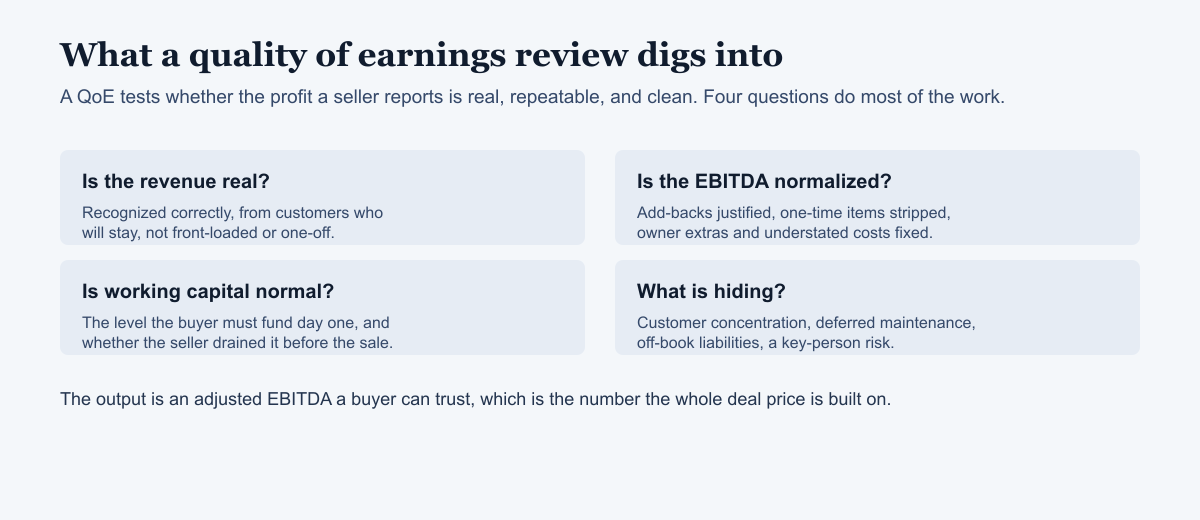
The central question is normalized EBITDA. A seller’s stated earnings are full of adjustments: owner salary above or below market, one-time legal costs added back, a personal vehicle run through the business, revenue recognized early. The QoE tests every add-back and strips out the ones that won’t repeat under new ownership. What’s left is the earnings a buyer can actually count on, and it’s often lower than the headline number. The report also probes revenue quality (is it recurring or one-off, concentrated in one customer or spread), and working-capital normalcy, because a target starved of working capital needs cash on day one that the buyer didn’t budget for.

This is also why a clean audit isn’t a substitute. An audit confirms last year’s statements followed the accounting rules. A QoE asks a different question entirely: are these earnings sustainable, and is the EBITDA you’re paying a multiple on real? A company can pass every audit and still have earnings that fall apart the moment you normalize them.
What drives the price
The range is wide because two deals are never the same amount of work.
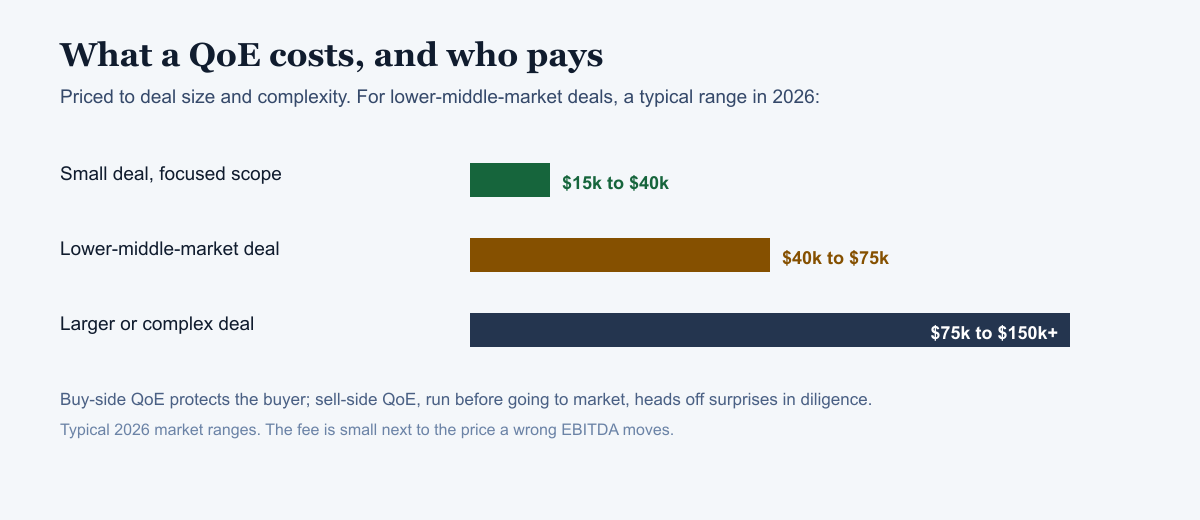
Deal size is the first driver, because a bigger transaction justifies deeper work and carries more risk if the earnings are wrong. The second is complexity: a single-entity business with clean QuickBooks and few add-backs is fast, while a target with several legal entities, related-party transactions, weak internal records, or aggressive adjustments takes far longer to untangle. Scope matters too. A full QoE that covers revenue, EBITDA, working capital, and debt costs more than a limited-scope review of just the earnings. The cheapest QoE is the one on a clean, simple, well-documented business, and the messiness that raises the price is usually the same messiness that most needs investigating.
Buy-side or sell-side: who orders it, who pays
Almost always the buyer, because the QoE is a due-diligence step and diligence is the buyer’s job. The buyer commissions the report, the buyer pays, and the buyer uses the findings to confirm the price or to renegotiate it downward when normalized EBITDA comes in below the seller’s number.
But sellers order them too, ahead of time. A sell-side QoE, run before the business goes to market, lets a seller find the weak spots in their own numbers and fix or explain them before a buyer’s analyst does. It defends the asking price and prevents the nasty surprise of a buyer’s QoE knocking the offer down mid-deal. On a given transaction, each side may run its own, and the two reports become the terms of the negotiation.

For a small acquisition, weigh the QoE fee against the deal. Spending $30,000 to verify the earnings on a $3 million purchase is cheap insurance; spending it on a $400,000 deal may not pencil, and a lighter review might do. The point is to match the depth of the diligence to what’s at risk.
Whichever side you’re on, the QoE only means something against a valuation. The business valuation calculator and the guide to valuation multiples show how the normalized EBITDA a QoE produces turns into a price, and a fractional CFO is often who runs the sell-side prep. If you’re granting equity rather than selling, that’s the separate world of the 409A valuation; the rest of the valuation section covers how deals get priced. These cost ranges are typical 2026 market figures, not a quote, and a QoE is an accounting engagement, not advice: scope and price come from the firm you hire.